Robert Motherwell, Rafael Alberti, and others
Black
1982
Scroll

Physical Qualities
Unbound volume with letterpress text and color brush and tusche lithographs, Book: 433 x 423 x 58 mm. (17 1/16 x 16 5/8 x 2 5/16 in.)
Sheet (page): 392 x 380 mm. (15 7/16 x 14 15/16 in.)
Credit Line
The Ryda Hecht Levi Collection of Illustrated Books, Bequest of Ryda H. Levi, Baltimore
Object Number
2009.38
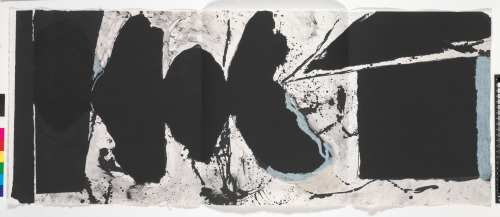
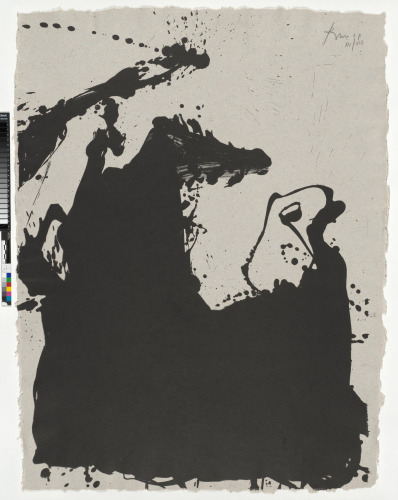
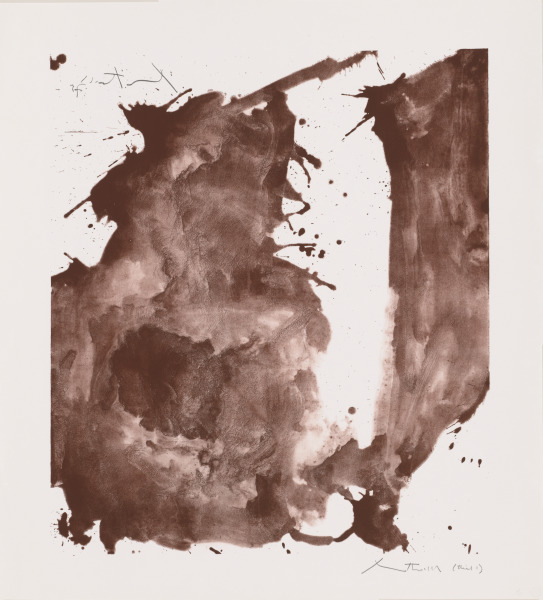
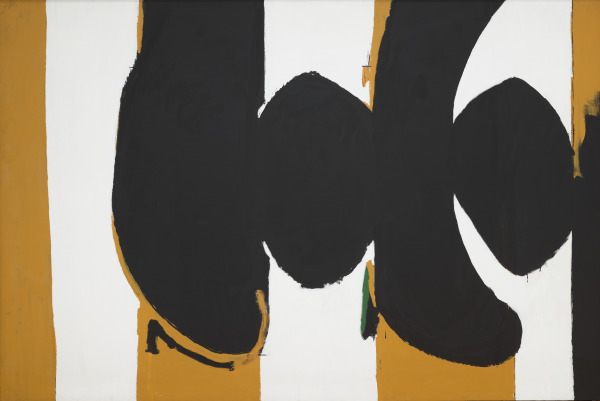
As their titles make plain, "Elegy Study I" and "Elegy Black Black" both feature the abstract form that Robert Motherwell called the “elegy,” a central and recurring motif in his work. Motherwell described this form, created through alternating oval and rectangular shapes, as “silent, monumental, more architectonic, a massing of black against white, those two sublime colors.” For Motherwell the dark and somber forms evoked historical tragedies.
Having first hit upon the motif in one of his drawings in 1948, he explored the “elegy” in his paintings, then revisited the motif in his gestural lithographs. In the large-scale "Elegy Study I" we see it expressed expansively; in "Elegy Black Black" the motif unfolds across the page, abutted by geometric forms and paired with lines from Spanish poet Rafael Alberti’s 1980 poem Negro Motherwell [Motherwell in Black].
The Baltimore Museum of Art by bequest, 2009; Ryda H. Levi, Lutherville, MD; Sylvia Cordish Fine Art, Baltimore, 1983
Darsie Alexander, "Robert Motherwell: Meanings of Abstraction,"Baltimore Museum of Art, May 20, 2006 - July 30, 2006.
Rena Hoisington, The Baltimore Museum of Art, "New Arrivals: Gifts of Art for a New Century," February 7-May 8, 2016.
Rena Hoisington, The Baltimore Museum of Art, "New Arrivals: Gifts of Art for a New Century," February 7-May 8, 2016.
Inscribed: on colophon, lower center in black ink: "Motherwell / 36/51"
Artist
Robert Motherwell
1914–1990
born Aberdeen, WA 1915; died Provincetown, MA 1991
Meet Robert Motherwell