






Sandro Botticelli
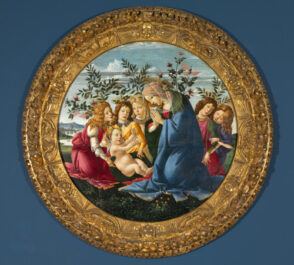
Madonna Adoring the Child with Five Angels
1484-1489
Physical Qualities
Tempera and oil on wood panel, 52 1/4 in. diam. (132.7 cm.)
Credit Line
The Mary Frick Jacobs Collection
Object Number
1938.226
The serenity of the early Renaissance fills this large circular frame. Five angels clothed in luxuriant red and yellow robes cluster behind the Madonna, who kneels in silent worship before the Christ Child. Sunlight illuminates the folds of the Madonna's delicate veil and the beautiful smooth faces of the young angels.
By placing the Madonna and the wingless angels in an outdoor landscape with hills, lake, boat, clouds and wildflowers, Botticelli abandoned the medieval notion of the Madonna as queen of a golden heaven, choosing instead to place her in an idealized earthly realm. Nevertheless, traditional symbolism remains important. The roses are the Madonna's special flower, and the olive branches symbolize the peace that the Christ Child will bring into the world.
The Botticelli painting and its Renaissance-style frame have undergone conservation treatment generously funded by Frederick Singley Koontz in memory of Anne Katherine Singley Koontz.
In the course of the frame's restoration, extensive testing was undertaken to determine its age. Results suggest it could be dated from the mid-eighteenth century to the early-nineteenth century. The frame was later adjusted insize to accomodate this painting, but it is not known precisely when this occurred and no documentation exists about the painting's original Renaissance period frame. As such, the impresive design of the present frame with its frieze of angel heads, alternating with exotic plants, represents a later interpretation of a Reinassance period style. Many of the Museum's old master paintings were acquired by patrons in the late nineteenth century, and as the painting and frame have been joined since that time, they provide a valuable illustration of how nineteenth-century collectors chose to present the art of the Reinassance.
The Baltimore Museum of Art by bequest, 1938; Mary Frick Jacobs, Baltimore, MD by purchase, 1912; Blakeslee Galleries, New York, NY, 1912; private collector by purchase, 1905; Thomas Agnew & Sons Ltd.; Ashburton Collection Sale, Christie’s London, July 8, 1905, lot 12; Lady Louisa Ashburton by descent, 1864; Lord Ashburton, Sir William Bingham Baring by purchase, 1863; Bromley Collection Sale, Christie’s London, June 12, 1863, lot 85; The Reverend Walter Davenport Bromley, London, UK; Cardinal Joseph Fesch, Rome.
Burlington House, “Old Masters Exhibition,” 1904.
The Baltimore Museum of Art, “200 Objects in The Baltimore Museum of Art: A Picture Book,” 1955.
The Baltimore Museum of Art, “The Baltimore Museum of Art: Celebrating a Museum,” 2014.
The Baltimore Museum of Art, “200 Objects in The Baltimore Museum of Art: A Picture Book,” 1955.
The Baltimore Museum of Art, “The Baltimore Museum of Art: Celebrating a Museum,” 2014.
G. F. Waagen, Treasures of Art in Great Britain, vol. 3 (London: John Murray, 1854), p. 376.
G.N. Plunkett, Sandro Botticelli (London: George Bell & Sons, 1900), p. 101.
J.A. Crowe and G.B. Cavalcaselle, A History of Painting in Italy, vol. 4 (New York: Charles Scribner’s Sons, 1911), pp. 261, 266.
Y. Yashiro, Sandro Botticelli, vol 1 (London: The Medici Society, 1926), p. 238.
B. Berenson, Italian Pictures of the Renaissance (Oxford: Clarendon Press, 1932), pp. 101, 102.
B. Caroll, “Floral Symbolism in an Early Florentine Painting,” Baltimore Museum of Art News 18, no. 2 December 1954, pp. 1–3.
Elizabeth Packard, “The Restoration of Two Paintings in the Jacobs Collection,”
Baltimore Museum of Art News 18, no. 2 December 1954, pp. 3–5, 8–9.
The Baltimore Museum of Art, “200 Objects in The Baltimore Museum of Art: A Picture Book,” 1955, p. 18.
The Baltimore Sun (Baltimore, MD) December 22, 1975., pp. 8–9, repr.
B. Berenson, Italian Pictures of the Renaissance: Florentine School, vol. 1 (London: Phaidon Press, 1963), p. 33.
G. Mandel and C. Bo, L’Opera completa del Botticelli (Milan: Rizzoli, 1967), p. 99, no. 92.
Burton B. Fredericksen and Federico Zeri, Census of Pre-Nineteenth-Century
Italian Paintings in North American Public Collections (Cambridge: Harvard University Press, 1972), p. 33.
Gertrude Rosenthal, ed., Italian Paintings XIV-XVIIIth Centuries from the collection of The
Baltimore Museum of Art (Baltimore, 1980), pp. 55–65, ill. p. 54.
Lisa Venturini, Francesco Botticini, Florence: EDIFER - Edizioni Firenze, 1994.
“A Grand Legacy,” Baltimore Museum of Art News (January-February 2003), pp. 4-5 ill.
“60 Objects Countless Stories,” BMA Today (Winter 2008–2009), pp. 6-7, ill. p. 6.
Fillion, Susan. Miss Etta and Dr. Claribel: Bringing Matisse to America. Boston: David R. Godine, 2011, page 21.
The Baltimore Museum of Art, “The Baltimore Museum of Art: Celebrating a Museum,” 2014, pp. 34–35.


 On View at the BMA
Explore the Collection Further