






Aaron Willard
Shelf Clock
1814-1824
Physical Qualities
Cherry, white pine, paint, gilt, glass, metal, enamel, brass, Overall: 34 7/8 x 13 3/8 x 6 in. (88.6 x 34 x 15.2 cm)
Case: 29 1/8 in. (74 cm)
Credit Line
Gift of Mrs. Francis White, from the Collection of Mrs. Miles White, Jr.
Object Number
1973.76.233.1
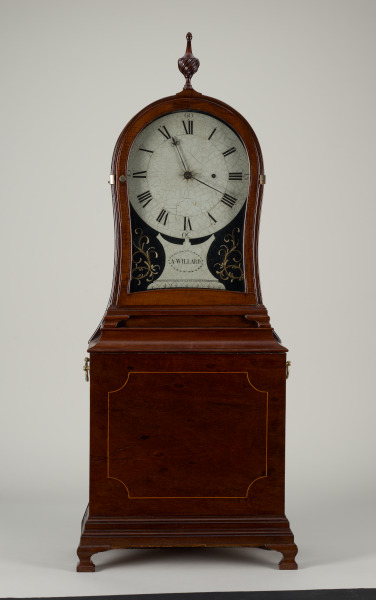
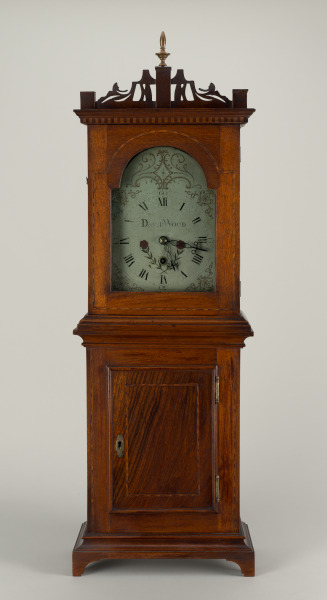
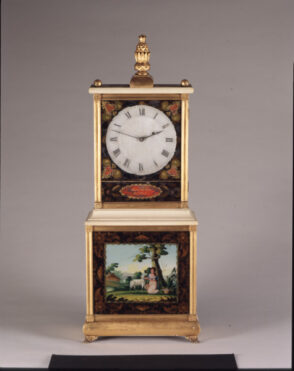
Aaron Willard, the youngest of four clock-making brothers working in and around Boston, ran what was essentially a factory that efficiently produced clocks in great numbers. But American clocks with whitepainted cases are rare and probably were “bespoke”—specifically ordered by individual clients. Although this eight-day clock was created as a practical household instrument for measuring the passage of time, its elegant decoration invites a more poetic response. The pineapple was an important symbol of welcome in colonial and Federal America. The painted image of a young lady garlanding a sheep with a chain of flowers conjures a romanticized bucolic existence far from the “time-is-money” commercial climate of the United States, which witnessed Willard’s clock factory as a harbinger of mass production.
Mrs. Miles White Jr., Baltimore; Francis White; Nancy Brewster White (Mrs. Francis); Baltimore Museum of Art, by gift, 1973
David Park Curry, The Baltimore Museum of Art, "PAINT! Japanned, Ebonised, Grained, and Polychromed Furniture", December 2006-November 2012.
Miller, Edgar G. American Antique Furniture: Book for Amateurs. Vol 2, Baltimore, Lord Baltimore Press, 1937, p. 959, no. 1922, ill. p. 961.
Elder III, William Voss and Jayne E. Stokes. American Furniture 1680-1880: From the Collection of the Baltimore Museum of Art. Baltimore: Museum of Art, 1987, p.122-123, ill. 88.


 On View at the BMA