




Tsuzureya
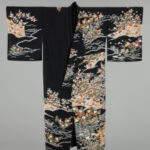
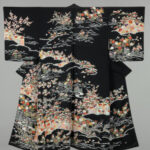
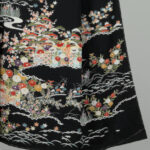
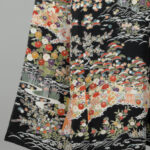
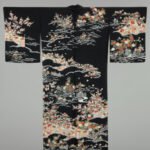
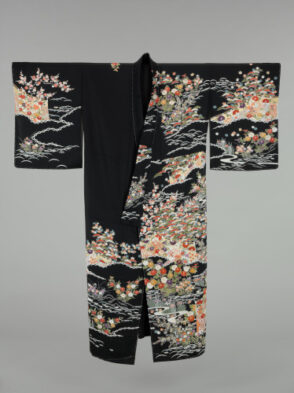
Western Woman’s Short Sleeved Black Kimono
2009
Scroll

Tsuzureya
Western Woman’s Short Sleeved Black Kimono
2009
Physical Qualities
Silk, dye, pigment, metal foil, metal-leafed paper strips wrapped around silk or cotton thread core, silk embroidery threads, silk lining
, 62 1/2 × 56 1/2 in. (158.8 × 143.5 cm.)
Credit Line
Gift of Charles W. Newhall III, Baltimore
Object Number
2014.81.1
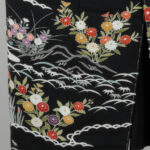
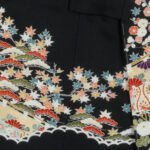
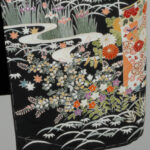
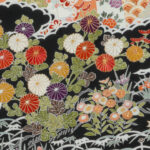
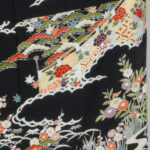
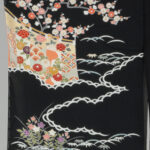
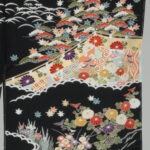
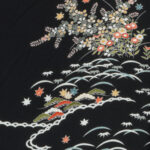
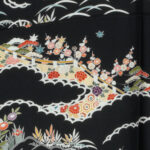
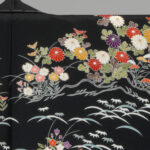
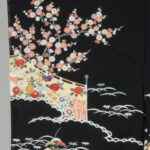
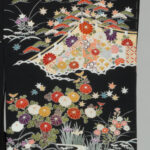
The enduring appeal of Heian motifs is evident on this kimono, which was commissioned for an American woman within this decade. Suspended curtains of the type used for dance performances during the Heian Era (794–1185) decorate the garment. Within the Heian court, dancing ability was so admired that a nobleman who delivered a splendid performance could rise in rank, as did Prince Genji in The Tale of Genji.
Although the extensive decoration on this short sleeve black kimono and the absence of family crests signal that it was made for a foreigner, the beauty of the elaborate yuzen dyeing, applied gold leaf (surihaku), and the presence of the Heian dance curtain, testify
to the continuity of skill and subject matter in current Japanese kimono production.
The long stitches (basting) around the lower skirt of the kimono (used to keep the lining flat until wearing) create a pine needle motif on each corner. Pine needles resemble the Japanese character for “human” and a pair represents a happy couple.
The Baltimore Museum of Art by gift, 2014; Charles Newhall, Baltimore by purchase, Tokyo, Japan
Anita Jones and Ann Marie Moeller, The Baltimore Museum of Art, Baltimore, MD, "Kimono and Obi: Romantic Echoes from Japan's Golden Age," July 10, 2016 - January 15, 2017.
Inscribed: A long envelope with gold Japanese lettering accompanies this kimono. The envelope contains 2 pieces of silk, half dyed in black belonging to the woman's kimono; Inscriptions printed in black on sample Fragment A include: "1304204" and red stamp with Japanese characters, Reverse Side: printed in black: "5994," "3043," "3" and red stamp wiith Japanese characters.
Manufacturer and Retailer
Tsuzureya
2000–2000
Address per Ginza internet site is: Tsuzureya Building, 5-8-3 Ginza, Chuo city, Tokyo.
Meet Tsuzureya