





John and Hugh Finlay and Francis Guy
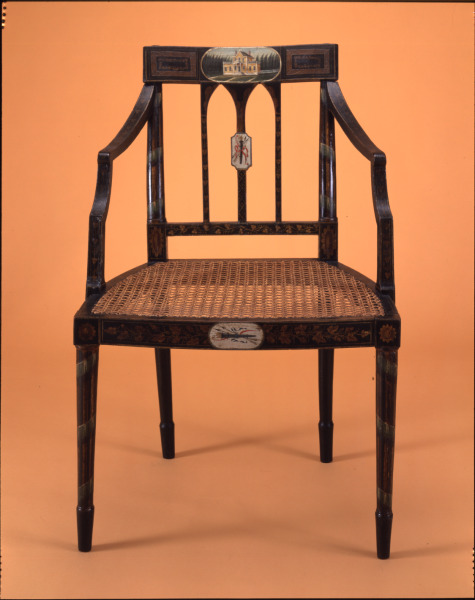
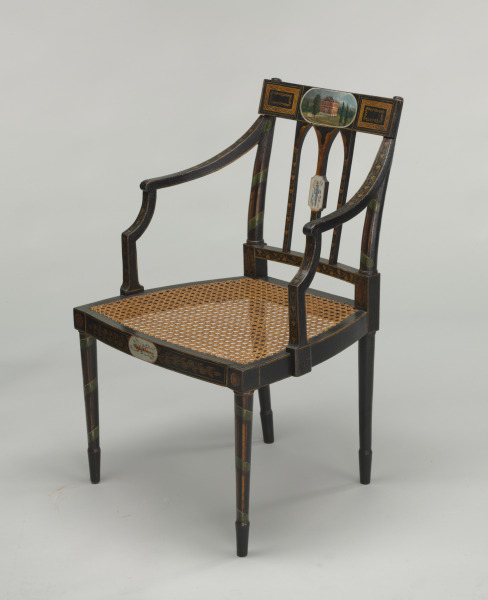
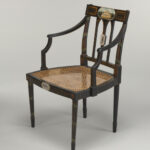
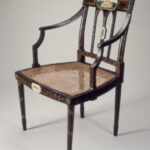
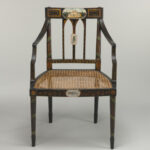
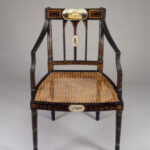
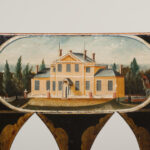
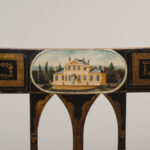
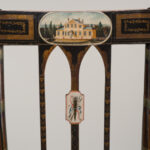
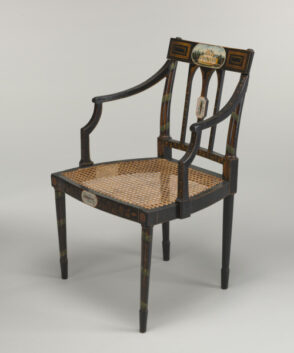
Armchair with a view of Willow Brook
1799-1809
Scroll

- Workshop: John and Hugh Finlay
- Decorator: Francis Guy
Armchair with a view of Willow Brook
1799-1809
Physical Qualities
Wood, painted; with polychrome and gilt decoration, 33 5/8 x 22 1/4 x 21 5/16 in. (85.4 x 56.5 x 54.1 cm.)
Credit Line
Gift of Lydia Howard de Roth and Nancy H. DeFord Venable in Memory of their Mother, Lydia Howard DeFord; and Purchase Fund
Object Number
1966.26.6
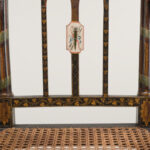
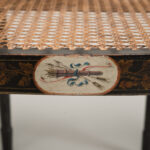
The caning of this chair seat is made from the bark of rattan, a vine-like plant native to tropical regions of Asia and Africa. Prior to electric fans and air conditioning, woven or cane seats were popular in the humid climate of Maryland, since the open pattern provided breathability and an easy-to-clean surface. When a weaver in the Finlay furniture factory crafted this seat, Baltimore’s harbor was rapidly becoming a center for global trade. Much like today’s trade economy, the raw materials for this chair were sourced from around the world before being transported to Baltimore, where they were assembled into a final piece and then sold for a profit. While international trade supports the global economy, using local renewable or recycled materials to create goods like furniture can support a healthier environment.
The Baltimore Museum of Art, "Baltimore Furniture: The Work of Baltimore and Annapolis Cabinetmakers from 1760-1810", February 21-April 6, 1947, p. 154-157.
Museum and Library of Maryland History, "Francis Guy and His Maryland Career", April 10-August 15, 1981
Dr. David Park Curry, "PAINT! Japanned, Ebonised, Grained, and Polychromed Furniture in the Baltimore Museum of Art", December 2006-
Museum and Library of Maryland History, "Francis Guy and His Maryland Career", April 10-August 15, 1981
Dr. David Park Curry, "PAINT! Japanned, Ebonised, Grained, and Polychromed Furniture in the Baltimore Museum of Art", December 2006-
Katherine Scarborough, Unique Record of Baltimore Mansions, 'The Baltimore Sun,' March 1, 1936, p. 11
BMA 'News,' June 1944, pp. 4-5
'Antiques,' Vol. XC, No. 3, Sept. 1966, p. 374, repro. 66.26.8
Elder, William Voss. Baltimore Painted Furniture, 1800-1840. Baltimore, MD: Baltimore Museum of Art, 1972, cat no. 3, page 24.
Lance Humphries, "Provenance, Patronage, and Perception: The Morris Suite of Baltimore Painted Furniture," "American Furniture," 2003, p. 199, ill.
Mary Ellen Hayward and Frank R. Shivers, Jr. , 'The Architecture of Baltimore: An Illustrated History.' Baltimore: The Johns Hopkins University Press, 2004, p.37, ill.
Baltimore Museum of Art. The Baltimore Museum of Art: Celebrating a Museum. Baltimore: The Baltimore Museum of Art, 2014.
Benskin, Elizabeth, and Suzy Wolffe. Teacher's Guide to the American Collection. Baltimore, MD: Baltimore Museum of Art, 2014, pages 29 and 37.


 On View at the BMA