





Jingdezhen kilns
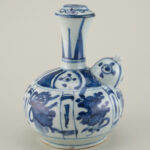
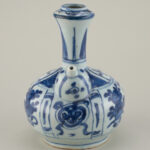
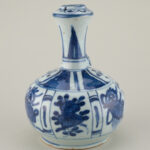
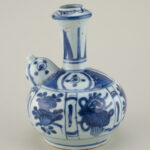
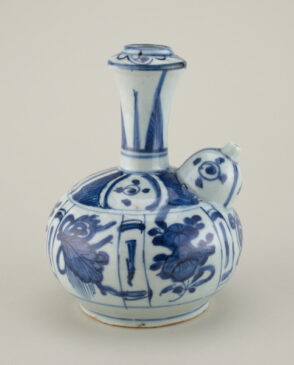
Drinking Vessel (Kendi) Decorated with Floral Panels
1566-1619
Scroll

Jingdezhen kilns
Drinking Vessel (Kendi) Decorated with Floral Panels
1566-1619
Physical Qualities
Porcelain with underglaze cobalt decoration, 7 13/16 x 5 7/8 x 5 3/4 in. (19.8 x 14.9 x 14.6 cm.)
Credit Line
Gift of Mrs. J.H. Mason Knox, Jr., from the Estate of Julia Rogers
Object Number
1945.22.2
This type of vessel, used for drinking water, was popular throughout Southeast Asia. Indian traders and missionaries introduced the form in the late 2nd century BCE. Its Malayan name, kendi, dervies from the Sanskrit kundika, a Hindu and Buddhist ritual vessel used to pour water for drinking, washing, or purification. In China, the vessels served as water-droppers to make ink. In the Philippines and Indonesia, they were used in marriage ceremonies, burial rites, and divination. In Iran, Spain, Portugal, the Nerherlands and England, they were displaced as decorative objects.
The Baltimore Museum of Art by gift, 1945; Marion Bowdoin Knox (Mrs. J.H. Mason Knox, Jr.) by bequest, 1945; Miss Julia R. Rogers, Baltimore
Collection installation, "Asia. Islands across Asia: Crossroads," Levy Gallery, Baltimore Museum of Art, October 5, 2023-


 On View at the BMA