






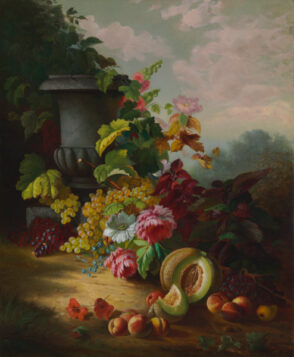
Andrew John Henry Way
Flora and Pomona
1872
Physical Qualities
Oil on canvas, Framed: 61 1/2 x 54 x 6 1/2 in. (156.2 x 137.2 x 16.5 cm) Sight: 48 1/2 x 39 1/4 in. (123.2 x 99.7 cm)
Credit Line
Gift of Stiles Tuttle Colwill, Lutherville, Maryland
Object Number
2008.285
Andrew John Henry Way’s largest known canvas reveals the exuberant sense of plenty that permeated prosperous circles in late 19th-century Baltimore. The painting’s title refers to two Roman mythological figures — Flora, the goddess of flowers, and Pomona, the goddess of fruitful abundance. Immensely popular with the city’s thriving collectors, Way’s still life paintings graced many a local parlor. However, this canvas —perhaps his most ambitious — remained with his descendants until early in the 21st century.
The Baltimore Museum of Art by partial gift, 2008 (completed 2015); Stiles Tuttle Colwill, Lutherville, MD by purchase, 1997; Alex Cooper Auction; Marjorie Clark, Butler, MD, by descent; Lyla Way, by descent; the artist
Inscribed: Canvas signed and dated bottom left: A.J.H. Way 1873
Markings: None.

 On View at the BMA