




George Liwukang Bukurlatjpi and Yolngu
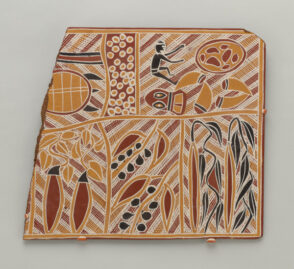
Hunting Scene
Yolngu, 1967-1970
Scroll

Physical Qualities
Masonite, paint, 13 11/16 x 12 x 3/16 in. (34.7 x 30.5 x 0.5 cm.)
Credit Line
Gift of Dr. John Money, Baltimore
Object Number
2000.312
Here, a human figure hunts in one scene while vegetables and a half-turtle form fill the fragmented canvas. Although George Liwukang Bukurlatjpi began his career by painting on strips of bark, in the late 1960s, he started to experiment with different supports like Masonite, a material made of compressed wood fibers, to make his work more appealing to American and European patrons. Many Aboriginal artists similarly pivoted their creative approach in the 20th century, when the Australian government began to promote Aboriginal art on the international market in the hopes of encouraging greater tourism.
The Baltimore Museum of Art by gift 2000; Dr John Money
Kevin Tervala, "Oceanic Art Collection Installation" (December 12, 2021 - Indefinite)
Kevin Tervala, "Oceanic Art at The Baltimore Museum of Art," Tribal Arts Magazine 104 (Summer 2022): 106-113. Illustrated on pg. 112.
Inscribed: On back side, painted in light brown: 'T TH S S DE'


 On View at the BMA
Explore the Collection Further