




Man Ray
Jean-Louis Barrault
1932
Scroll

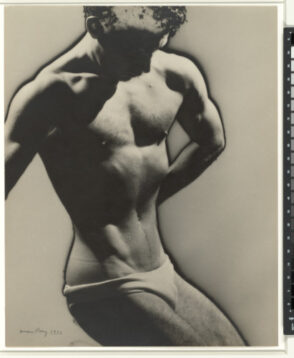
Man Ray
Jean-Louis Barrault
1932
Physical Qualities
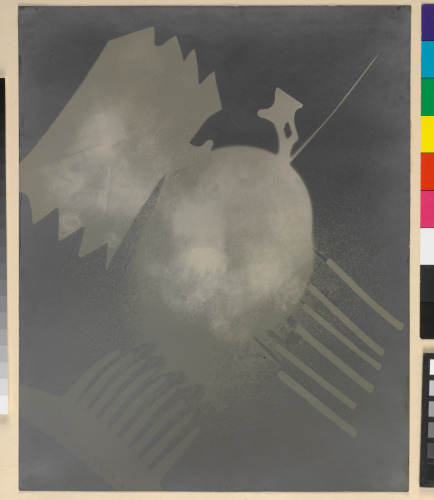
Solarized gelatin silver print, Image/Sheet: 283 x 227 mm. (11 1/8 x 8 15/16 in.)
Credit Line
Purchase with exchange funds from the Edward Joseph Gallagher III Memorial Collection; and partial gift of George H. Dalsheimer, Baltimore
Object Number
1988.431
Man Ray began using solarization in his photographs in 1929. This partial and unpredictable reversal of tones was the result of exposing a still-developing negative or print briefly to light. Man Ray claimed to have stumbled upon the technique when
his studio assistant Lee Miller accidentally turned on the darkroom light while he was developing negatives. (The procedure is also sometimes referred to as the Sabattier effect after Armand Sabattier, who discovered the process in 1862.) Solarization offered Man Ray an exciting way to imbue his figures with an electrically-charged outline or a glowing aura.This was, he later said, “a chance to produce a photograph that would not look like a photograph.”
Rena Hoisington, BMA, "Looking through the Lens: Photography 1900-1960," 16 March - 8 June 2008.
Jan Howard, BMA, "Surrealist Art from the BMA's Collection," 31 March - 20 June 1999.
Jan Howard, BMA, "The Collector's Eye: Photographs from the Museum's Dalsheimer Collection," 17 September - 19 November, 1989.
Jan Howard, BMA, "Surrealist Art from the BMA's Collection," 31 March - 20 June 1999.
Jan Howard, BMA, "The Collector's Eye: Photographs from the Museum's Dalsheimer Collection," 17 September - 19 November, 1989.
Jean-Hubert Martin, "Man Ray: Photographs" (London: Thames & Hudson), ill. 121 (smaller version)
Michael Taylor, "Man Ray: The Paris Years," (Richmond: Virginia Museum of Fine Arts, 1921), ill. 73 p. 189
Inscribed: At lower left, in graphite: "Man Ray 1930"