





Coptic
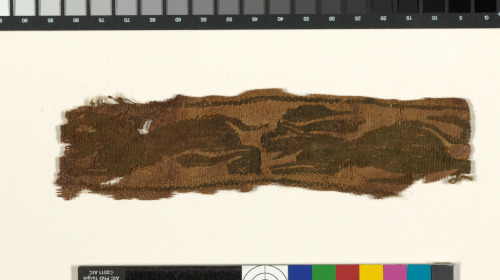
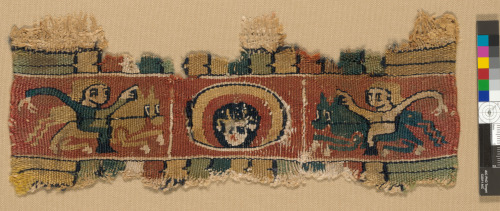
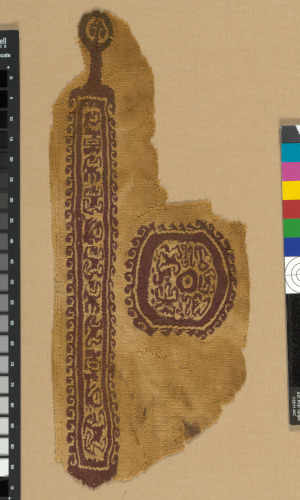
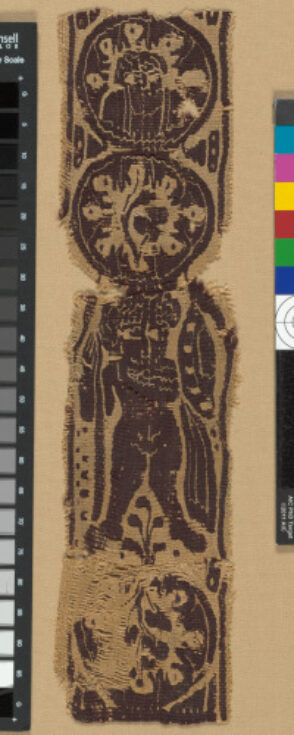
Fragment of Clavus with Dancer and Portrait Medallion
Coptic, 301-700
Physical Qualities
Linen, wool, 10-1/4 x 2-3/8 in. (26 x 6 cm.)
Credit Line
Gift of Dena S. Katzenberg, Baltimore
Object Number
1985.240
The figure depicted on this clavus belongs to the tradition of the war-like Pyrrhic dancer, although this figure’s stance is stiffer and more frontal than most. A portrait of a bearded man, perhaps a saint or memorial figure, appears in the roundel above. During the Coptic era, the human body was sometimes rendered in a naturalistic way, but stylization and exaggeration were also common. Recent scholarship suggests that this was not a progression of styles along a chronological timeline, but a case of varied traditions co-existing within the same period. The figures in this example are depicted in a simple, stylized manner with recognizable forms. The warrior/dancer displays a disproportionately large head, wedge-shaped eyes, and minimal internal detail. The pronounced eyes were possibly intended as a protection for the wearer against the “evil eye” or curse delivered through the evil gaze of others.
Baltimore Museum of Art by gift 1985; Dena S. Katzenberg, Baltimore, MD.
Anita Jones, The Baltimore Museum of Art, "Timeless Weft: Ancient Tapestries and the Art of Louise B. Wheatley", February 1–July 30, 2017.
Anita Jones, "Matisse-Designed Textiles", Baltimore Museum of Art, rotation in Berman Gallery, December 13, 2007-June 23, 2008, no catalog.Anita Jones,
Anita Jones, "Matisse-Designed Textiles", Baltimore Museum of Art, rotation in Berman Gallery, December 13, 2007-June 23, 2008, no catalog.Anita Jones,