February 12, 2026
BMA Presents Little-Known Matisse Illustrations Inspired by Martinique
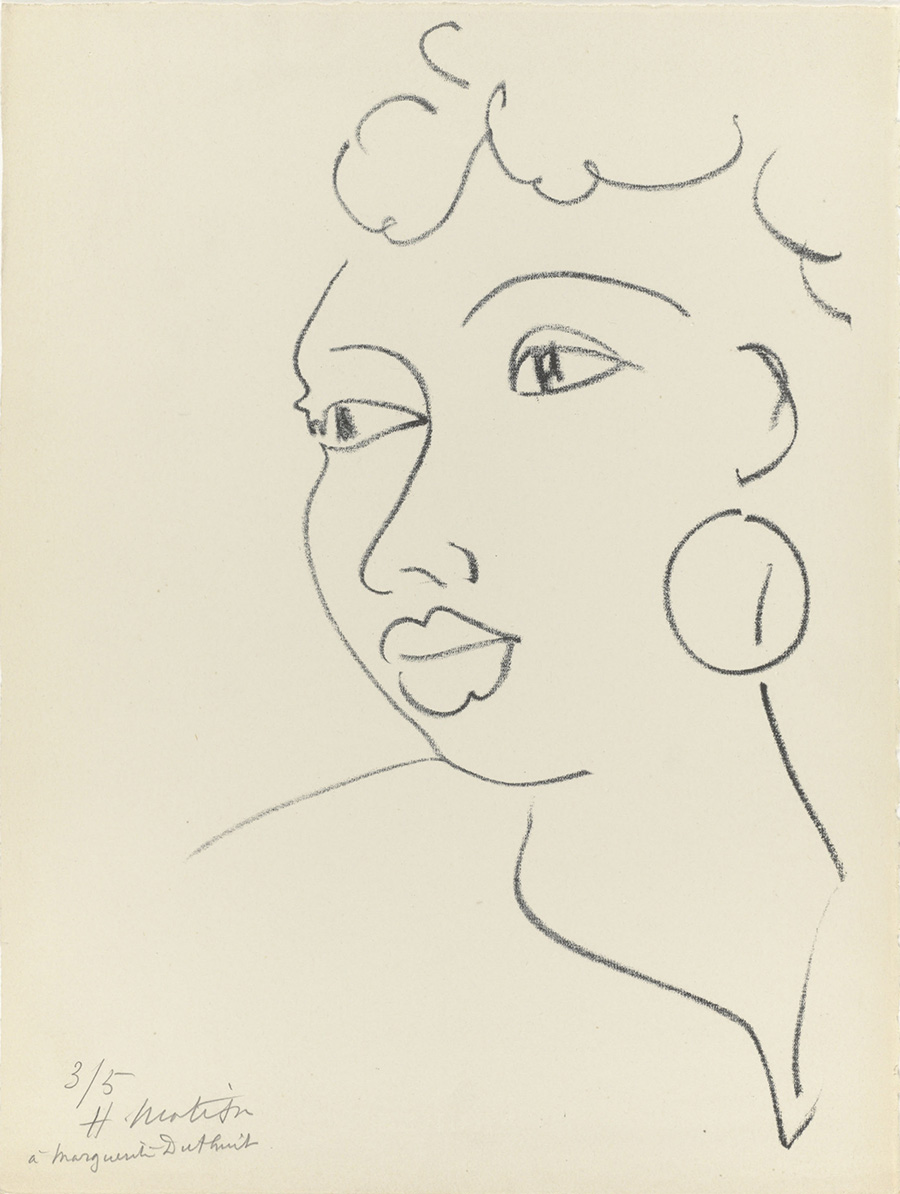
Matisse and Martinique: Portraits and Poetry reflects research developed as part of Ruth R. Marder Center for Matisse Studies Fellowship
BALTIMORE, MD (February 12, 2026)—On March 18, the Baltimore Museum of Art (BMA) will present a selection of lithographic portraits from the book Poésies Antillaises (Antilles Poetry), a little‑known illustrated book and associated works on paper by Henri Matisse that were in part inspired by the artist’s brief 1930 visit to the Caribbean island of Martinique. On view through October 25, 2026, Matisse and Martinique: Portraits and Poetry, spotlights Matisse’s illustrations and places them in dialogue with works by Serge Hélénon and Germaine Casse, two of the period’s leading artists from Martinique and Guadeloupe who challenged colonial-era representations of the region. The focus exhibition, which features approximately 20 works, illuminates Matisse’s extensive working relationships with several notable Caribbean and international models and considers the significance of transatlantic exchange to the development of modern art. The exhibition is the result of research conducted by guest curator Dr. Denise Murrell as the inaugural Ruth R. Marder Center for Matisse Studies Fellow.
Matisse traveled extensively throughout his career, finding inspiration while far away from home. He briefly visited Martinique and Guadeloupe in 1930 during the last decades of French colonial rule, which lasted from the late 1800s to the mid-1900s. Although his 28 lithographic portraits for Poésies Antillaises (1946-1953) were created during his lifetime, the illustrated book was not published until 1972, making it one of the least known projects of his career. Matisse’s distinctive single-line portraits enhance the poetry of his elder friend John Antoine Nau (French, born Eugène Léon Édouard Torquet, 1860–1918)—whose verses address female companions who inspire reveries of music, travel, and oceanic landscapes. Matisse’s images, while based on real models, capture his emotional response to the subject rather than a precise likeness. Several of Matisse’s models are identified in the exhibition. They include Haitian dancer Carmen Lahens, Belgian Congolese journalist Elvira Van Hyfte, and Martinican Catherine Dubois, who posed for Matisse as a pre‑teen in 1947. Interpretive texts emphasize the models’ agency and professional lives, situating their collaborations with Matisse within longer histories of friendship and exchange.
The exhibition also includes three gouaches and drawings by Serge Hélénon (French, born 1934) and one lithograph by Germaine Casse (French, 1881-1967), two artists of Martinican and Guadeloupian heritage respectively. Casse’s works—many of which have been lost—present idealized depictions of the French Caribbean coast, while Hélénon reimagines the French Mediterranean coast. These artists place the Poésies illustrations within a broader ongoing conversation about portrayals of the Caribbean in this period, offering multiple perspectives rather than a single, dominant view.
“The exhibition invites visitors to look closely at how poetry, portraiture, and artistic movements intersect across geographies,” said Asma Naeem, the BMA’s Dorothy Wagner Wallis Director. “By placing Matisse’s work alongside Caribbean artists who asserted their own visual languages, Matisse and Martinique expands how we understand modernism and the networks that shaped it.”
Matisse and Martinique: Portraits and Poetry is guest-curated by Dr. Denise Murrell, Merryl H. and James S. Tisch Curator at Large, Office of the Director, The Metropolitan Museum of Art, and Inaugural Fellow of the Ruth R. Marder Center for Matisse Studies at the BMA (2022–2025).
The exhibition is supported by The Pierre and Tana Matisse Foundation and Nancy Dorman and Stanley Mazaroff.
Matisse at the BMA
The BMA is home to the world’s largest public collection of works by Matisse, with more than 1,600 paintings, drawings, prints, and illustrated books. Its renowned holdings were first established in the early 20th century with a gift of 600 works from Baltimore sisters Claribel and Etta Cone. Since then, the BMA has more than doubled the size of the collection, including gifts from the Matisse family. The BMA has organized many acclaimed exhibitions on the artist and dedicated the Ruth R. Marder Center for Matisse Studies in 2021 to improve access to and advance scholarship of his work. Matisse and Martinique opens this March alongside Matisse in Vence: The Stations of the Cross and Fratino and Matisse: To See This Light Again. This suite of exhibitions draws on the museum’s collection, as well as loans from public and private collections to create a series of exceptional experiences for visitors.
About the Baltimore Museum of Art
Founded in 1914, the Baltimore Museum of Art (BMA) inspires people of all ages and backgrounds through exhibitions, programs, and collections that tell an expansive story of art—challenging long-held narratives and embracing new voices. Our outstanding collection of more than 97,000 objects spans many eras and cultures and includes the world’s largest public holding of works by Henri Matisse; one of the nation’s finest collections of prints, drawings, and photographs; and a rapidly growing number of works by contemporary artists of diverse backgrounds. The museum is also distinguished by a neoclassical building designed by American architect John Russell Pope and two beautifully landscaped gardens featuring an array of modern and contemporary sculpture. The BMA is located three miles north of the Inner Harbor, adjacent to the main campus of Johns Hopkins University, and has a community branch at Lexington Market. General admission is free so that everyone can enjoy the power of art.
Press Contacts
For media in Baltimore:
Anne Brown
Baltimore Museum of Art
Senior Director of Communications
abrown@artbma.org
410-274-9907
Sarah Pedroni
Baltimore Museum of Art
Communications Manager
spedroni@artbma.org
410-428-4668
Alina Sumajin
PAVE Communications
alina@paveconsult.com
646-369-2050