February 12, 2026
BMA to Present First Exhibition Dedicated to Matisse’s Exceptional Mural The Stations of the Cross
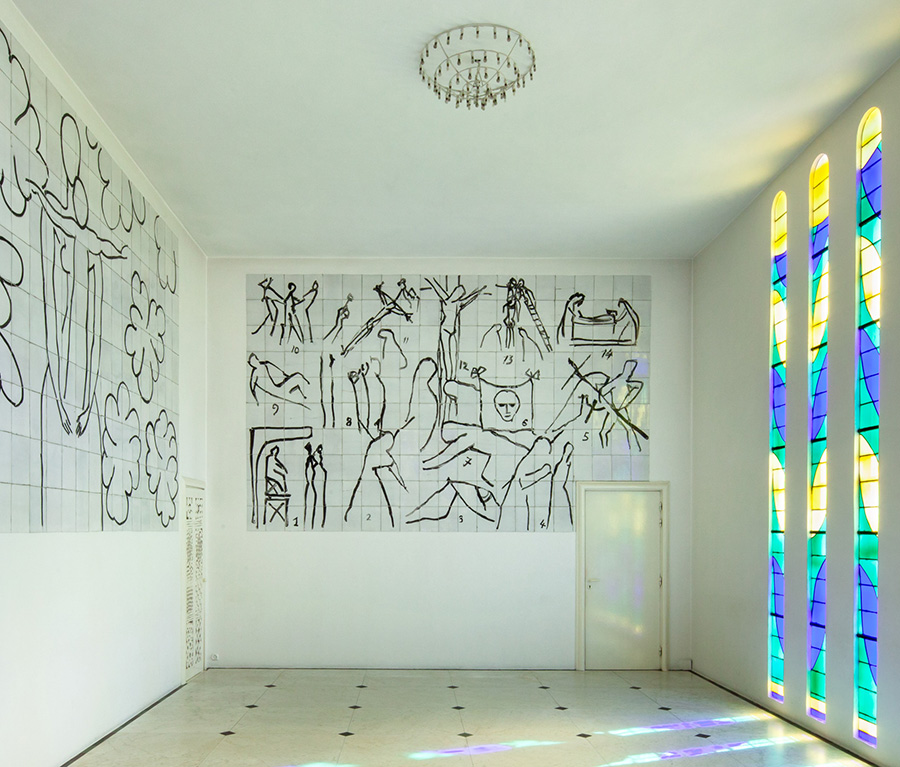
Matisse in Vence: The Stations of the Cross, co-organized with the Musée Matisse Nice, features more than 80 drawings shown together for the first time
BALTIMORE, MD (February 12, 2026)—On March 29, the Baltimore Museum of Art (BMA) will open the first exhibition to substantively explore Henri Matisse’s powerful mural The Stations of the Cross, which he created for his only architectural project, the Chapelle du Rosaire (Chapel of the Rosary) (1947-1951), in Vence, France. Matisse designed every detail of the building, from its remarkable stained-glass windows to the altar and priest’s vestments and to three large-scale black-and-white ceramic murals inside the chapel. The Stations of the Cross depicts Christ’s journey to Calvary and stands out in Matisse’s work for its narrative and rough, aggressive lines—starkly contrasting with the fluid, colorful style for which he is best known. Matisse in Vence: The Stations of the Cross—organized under the direction of Asma Naeem, Dorothy Wagner Wallis Director of the Baltimore Museum of Art and Aymeric Jeudy, Director of the Musée Matisse Nice—is the first exhibition to take up the monumental mural as its primary focus. It includes more than 80 drawings, never-before shown together, from the Musée Matisse Nice, the Dominican Sisters of Vence, and private collections, as well as a large-scale image of the completed work. The exhibition will remain on view through June 28, 2026.
Matisse in Vence: The Stations of the Cross is guest curated by Matisse scholar Yve-Alain Bois, Professor Emeritus, Institute for Advanced Study, Princeton, NJ, with assistance from Alix Agret, art historian and researcher. The BMA presentation is supported by Katy Rothkopf, the Anne and Ben Cone Memorial Director of the Ruth R. Marder Center for Matisse Studies and Senior Curator of European Painting and Sculpture. Matisse in Vence is opening as part of a suite of Matisse exhibitions that also includes Fratino and Matisse: To See This Light Again and Matisse and Martinique: Portraits and Poetry.
Matisse in Vence delves deeply into Matisse’s process and the development of the unique visual vocabulary of The Stations of the Cross mural and adds another important layer to our understanding of his work and evolving style of his late career. To augment this, the BMA’s exhibition will explore Matisse’s broader vision for the Chapel of the Rosary with a brief timeline outlining the creation process, photographs of Matisse working on the chapel, and thematic cards to guide close looking throughout the stations. Visitors can also access an audio guide featuring commentary from curators and Fr. Josemaría Guzmán-Domínguez from the JHU Dominican Church. A dedicated space at the end of the exhibition will feature an animation of the chapel as it develops, a video of Matisse, and a sketching activity.
The stars aligned for Matisse to design the chapel when he moved from Nice to nearby Vence in 1943 to escape the threat of bombardment during World War II. While there, he connected with Sister Jacques-Marie, who had been the artist’s nurse and sat for him as a model prior to taking her vows. She asked for his help in designing a stained-glass window for the damp garage space that the Dominican sisters of Vence were using as a chapel, and Matisse offered to create the entire church while she worked as an intermediary between the artist and the ecclesiastical authorities. Matisse designed every detail—from the priest’s vestments to the altar and windows—and it is considered one of the highlights of his late career. While aspects of the chapel, especially its stained-glass windows, have been widely celebrated, The Stations of the Cross mural remains under-recognized and under-studied within Matisse’s oeuvre, even as the artist himself considered it an important part of the overall achievement of the chapel.
The Stations of the Cross are a devotional practice in which Christian pilgrims undertake a spiritual journey from where Jesus was condemned to death by the Roman governor Pontius Pilate to his tomb. In the 17th century, churches began to commission representations of the journey, allowing believers to walk the path symbolically, with each depicted station representing a specific moment in the sequence of Jesus’s Passion. While Matisse’s mural of The Stations of the Cross embraces the underlying concept, it offers a radically different presentation than traditional depictions of the stations. Typically, one scene is depicted per station, so that a believer must walk from one to the next in order. Matisse brought the stations together into a single image, featuring 14 numbered stations shown on a serpentine path across the monumental mural. Although the elements of the journey still unfold one-by-one, they are experienced together and surround the poignant moment of Jesus’s crucifixion, heightening the sense of narrative and drama within the work. Matisse in Vence leads audiences through Matisse’s work to create the mural, revealing the many preparatory sketches and drawings that he produced to achieve the “graffiti”-like style that characterizes the work.
Matisse’s immediate knowledge of Christian imagery was limited, and he, therefore, relied on his collaborators—Sister Jacques-Marie, Brother Bertrand Rayssiguier, and Father Marie-Alain Couturier—to share the stories of the stations. He then directed models to pose for the scenes, allowing him to explore the meanings of the stations more fully and providing him opportunity to hone the simplistic and rough approach to the black-and-white mural. His extensive preparatory work, which forms the core of the exhibition, provides a rare and invaluable opportunity to explore the vision and creation of this truly singular work within Matisse’s extensive oeuvre.
“We are delighted to partner with Yve-Alain Bois and the Musée Matisse Nice to present Matisse in Vence, a compelling exploration of an exceptional Matisse work that honors our shared commitment to advancing new scholarship of the artist and his legacy,” said Asma Naeem. “While visitors to the BMA may be familiar with the iconic Matisse paintings in our Cone galleries, I think they will be truly surprised by The Stations of the Cross, which reveal a different and unexpected sensibility that deepens our understanding of this beloved artist. I look forward to sharing this under-recognized chapter in Matisse’s oeuvre with our many audiences.”
Tickets
Tickets are on sale beginning March 5. Prices are $10 for adults, $8 for seniors, $7 for groups of 7 or more, $5 for students with ID, and $5 for youth ages 7 to 18. BMA Members, children ages 6 and under, and student groups are admitted free.
Catalog
The exhibition is accompanied by a comprehensive catalog produced under the direction of Yve-Alain Bois, with contributions from Alix Agret and Aymeric Jeudy. The book has 208 pages and more than 160 illustrations. Both French and English editions are published by Éditions Bernard Chauveau.
Organization and Sponsors
Matisse in Vence: The Stations of the Cross is co-produced by the Musée Matisse Nice and the Baltimore Museum of Art. The BMA presentation is supported by Nancy Dorman and Stanley Mazaroff, The Pierre and Tana Matisse Foundation, and the Estate of Carolyn Lee Smith. The audio guide is made possible with support from the Lilly Endowment Inc.
Matisse at the BMA
The BMA is home to the world’s largest public collection of works by Matisse, with more than 1,600 paintings, drawings, prints, and illustrated books. Its renowned holdings were first established in the early 20th century with a gift of 600 works from Baltimore sisters Claribel and Etta Cone. Since then, the BMA has more than doubled the size of the collection, including gifts from the Matisse family. The BMA has organized many acclaimed exhibitions on the artist and dedicated the Ruth R. Marder Center for Matisse Studies in 2021 to improve access to and advance scholarship of his work.
About the Baltimore Museum of Art
Founded in 1914, the Baltimore Museum of Art (BMA) inspires people of all ages and backgrounds through exhibitions, programs, and collections that tell an expansive story of art—challenging long-held narratives and embracing new voices. Our outstanding collection of more than 97,000 objects spans many eras and cultures and includes the world’s largest public holding of works by Henri Matisse; one of the nation’s finest collections of prints, drawings, and photographs; and a rapidly growing number of works by contemporary artists of diverse backgrounds. The museum is also distinguished by a neoclassical building designed by American architect John Russell Pope and two beautifully landscaped gardens featuring an array of modern and contemporary sculpture. The BMA is located three miles north of the Inner Harbor, adjacent to the main campus of Johns Hopkins University, and has a community branch at Lexington Market. General admission is free so that everyone can enjoy the power of art.
Press Contacts
For media in Baltimore:
Anne Brown
Baltimore Museum of Art
Senior Director of Communications
abrown@artbma.org
410-274-9907
Sarah Pedroni
Baltimore Museum of Art
Communications Manager
spedroni@artbma.org
410-428-4668
Alina Sumajin
PAVE Communications
alina@paveconsult.com
646-369-2050