Exhibition Guide
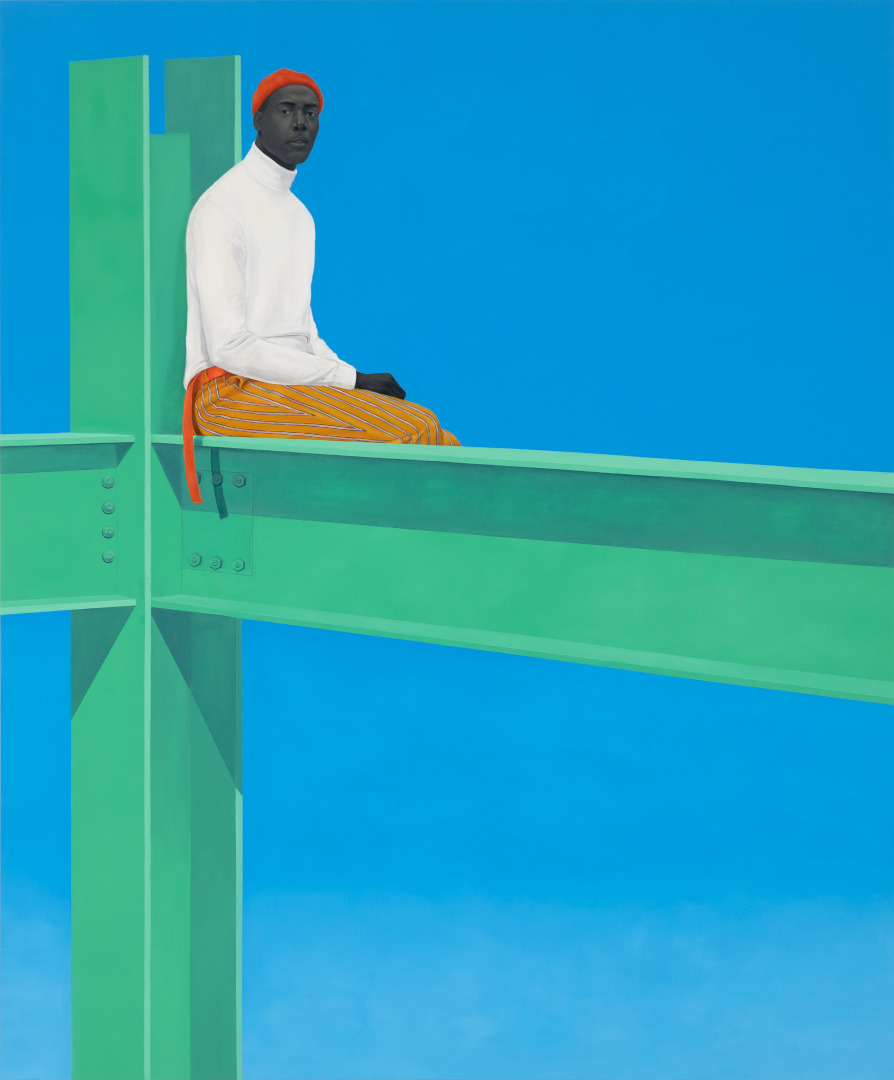
Amy Sherald. If you surrendered to the air, you could ride it. 2019. Whitney Museum of American Art, New York, purchase, with funds from the Painting and Sculpture Committee, Sascha S. Bauer, Jack Cayre, Nancy Carrington Crown, Nancy Poses, Laura Rapp, and Elizabeth Redleaf
If you surrendered to the air, you could ride it
Audio
If you surrendered to the air, you could ride it Visual Description
Read Transcript
Visual Description
[Narrator] “If you surrendered to the air, you could ride it” is a vertical oil on canvas painting of a person sitting alone looking straight ahead atop a steel beam in the sky.
[Amy Sherald] The painting you’re standing in front of is 130 inches by 108 inches.
[Narrator] The large size of this painting is striking and it is necessary to look up at the subject for a viewer of any height. The background of the work is a clear blue sky. Like the natural horizon, there is a gradient in the frame from a lighter tint of blue at the bottom to a deeper shade of the same hue at the top.
[Amy Sherald] The painting is a re-imagination of an iconic American photograph called “Lunch Atop a Skyscraper.”
[Narrator] “Lunch Atop a Skyscraper” is a 1932 photo attributed to Charles Clyde Ebbets of ironworkers having lunch midair that has become a defining symbol of U.S. labor, industry, and ambition.
[Amy Sherald] The way that I’ve reimagined this painting is with a single figure. The beams are not the color of regular beams, which you might think are black or brown, but I’ve painted them a very pale green, think Easter egg green. There is a gentleman sitting facing you. You can see his hands, but you can’t see his feet. His feet are on the back side of the beam, holding him steady. He has on a white turtleneck and he has on pants that have stripes on them. The main color of the pants are a golden ochre-y yellow. The stripes are navy blue with white and red. He has on an orange belt that would be the same color as the orange in candy corn. He also has on a hat. This hat is the same color as his belt. It’s a very deep juicy orange. He’s peering down at you, as you peer up at him.
[Narrator] The figure in the painting sits in an L-shaped corner where perpendicular beams meet. His dark skin tone is represented in deep hues on a grey scale. The era of this person’s styling is ambiguous in that it could represent trends from the 1960’s or early 2000’s. His orange knitted hat envelopes his short hair except for a small amount of sideburn. His hand rests on his thigh, and the tail of his belt draws the eye toward a set of six large bolts holding the structure together.
[Amy Sherald] The direction of light in this painting is coming from the top right-hand corner and there is a shadow cast on the center beam from that light and a little bit on the beam below. He’s sitting pensively with his hand relaxed near his knee, ready to engage you.
Artwork Label
Serene and smartly dressed, the figure in this work sits atop a steel beam, his attire at odds with the construction scene. The painting references a 1932 photograph often attributed to Charles Clyde Ebbets of ironworkers having lunch midair that has come to exemplify U.S. labor, industry, and ambition. Sherald often draws on imagery connected to American identity to rectify the exclusion of Black people from the histories these images have helped to shape. The work’s title is a sentence from Toni Morrison’s 1977 novel Song of Solomon that suggests letting go of fear in order to fly; the inherent danger of falling is left unspoken.