Exhibition Guide
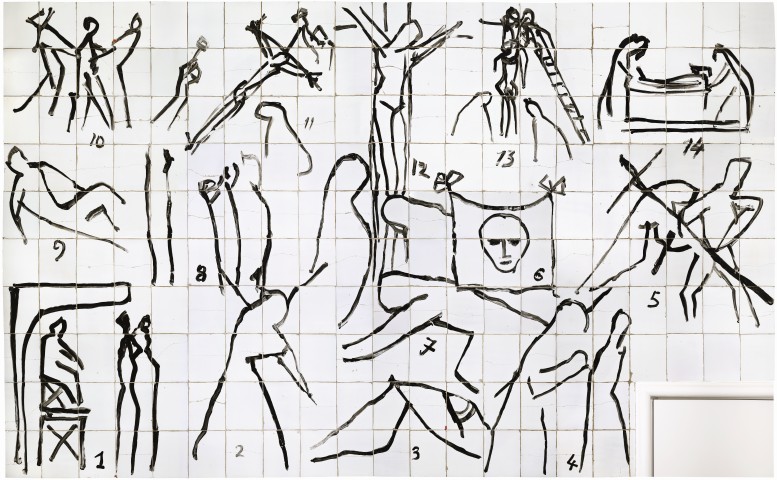
Henri Matisse. Overview of The Stations of the Cross, Chapel of the Rosary, Vence. All copyright-protected works by Henri Matisse © 2025 Succession H. Matisse / Artists Rights Society (ARS), New York. Photo: © Musée Matisse Nice/François Fernandez
The Stations of the Cross Mural Visual Description
Matisse painted a mural depicting the 14 Stations of the Cross, a Catholic story of Jesus’ journey from his trial to his execution and death, on white ceramic tiles using small groupings of figures organized in three rows. The expansive mural is installed above a doorway near the lower right corner and extends to the ceiling and nearly the full width of the back wall in the Chapel of the Rosary in Vence, France. The original mural measures 6.5 feet high and 13 feet wide and is composed of a grid of tiles. The grid is 10 tiles high and 21 tiles wide. This vinyl reproduction of the mural is scaled down from the original. Each scene of Jesus’ journey along the Stations of the Cross is numbered from 1 to 14 in Arabic numerals. The scenes begin in the lower left corner of the mural with Station 1 and snake upwards in an “S” shape, finishing in the upper right corner with Station 14. The figures, painted in black and appearing as outlined silhouettes, appear in various dramatic and expressive poses, some with outstretched arms, others reclining, or interacting with other figures. Loosely drawn and linear, the figures are sketch-like, focusing on movement and gesture to convey intense emotion rather than detailed representation.