For Families
Closing Program: The Way of Nature: Art from Japan, China, and Korea
Bring friends and family for an afternoon of music and art to celebrate the closing day of the exhibition The Way of Nature: Art from Japan, China, and Korea.
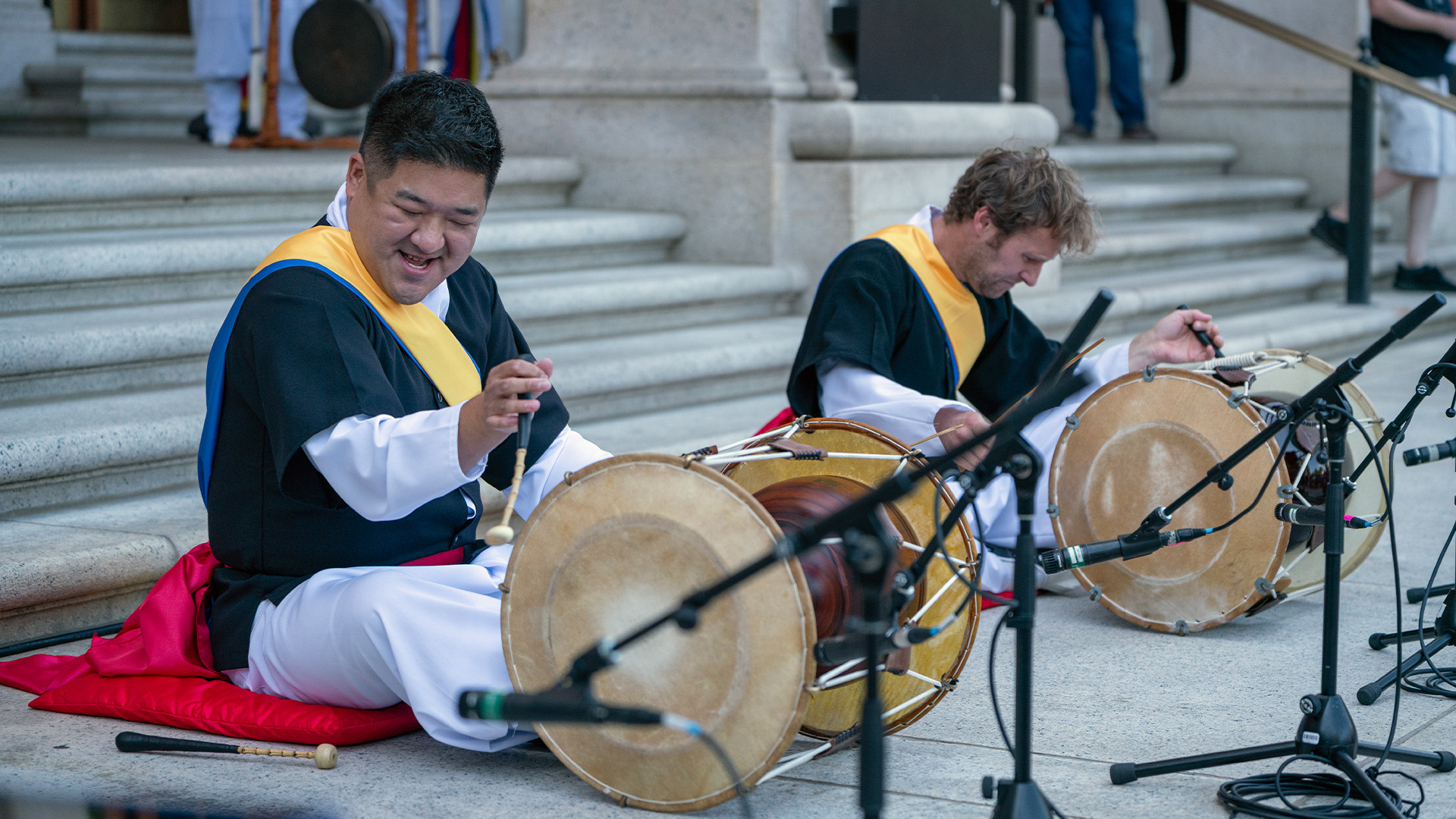
Enjoy an outdoor performance and interactive demonstration of Samulnori, a genre of traditional Korean percussion music, by Washington Samulnori on the Museum’s historic steps.
Afterward, explore the galleries with us. Join a Sunday Shorts tour with a BMA Gallery Guide. Then, explore The Way of Nature exhibition with artist and scientist Se Jong Cho and curator Frances Klapthor, which will be followed by art making. Learn about traditional Korean crafts and take home activity worksheets from the Korean Cultural Center, Washington, D.C.
This program is presented in partnership with the Korean Cultural Center, Washington, D.C.
Please see Accessibility at BMA for additional resources to support your visit.
Schedule
1–4 p.m. – Learn about traditional Korean crafts with the Korean Cultural Center, Washington, D.C.
Clair Zamoiski Segal and Thomas H. Segal East Lobby
1–1:45 p.m. – Performance and demonstration by Washington Samulnori
Historic Merrick Entrance steps (outdoors)
2–2:30 p.m. – Sunday Shorts
Tours begin in the Clair Zamoiski Segal and Thomas H. Segal East Lobby
2:30– 3:15 p.m. – In-gallery guided exploration and Part 1 of Experiential Art Making with artist and scientist Se Jong Cho and Frances Klapthor, BMA Associate Curator of Asian Art, The Way of Nature: Art from Japan, China, and Korea
Contemporary Gallery (Level 3)
3:15–4 p.m. – Part 2 of Experiential Art mMaking with artist and scientist Se Jong Cho
Joseph Education Center Insight Lab
About Our Partner
The Korean Cultural Center, Washington, D.C. (KCCDC), celebrates all things Korea. As a branch of the Embassy of the Republic of Korea, the KCCDC introduces Korean culture to American audiences and promotes cultural exchange through a wide range of public programs, including free performances, exhibitions, film screenings, community outreach, and institutional partnerships. The KCCDC is open to visitors Monday through Friday (10 a.m.–12 p.m. and 1–5 p.m.), with no appointment necessary. Stop by to explore our latest exhibition, pick up free materials about Korea, or relax in one of our cultural spaces.
About the Participants
Washington Samulnori
Washington Samulnori is a Korean traditional percussion performing troupe that is dedicated to performing and preserving Samulnori. The Korean words sa and mul mean “four things” and nori means “to play.” In the case of Samulnori, it refers to the four musicians playing four different types of percussive instruments: the changgo (hourglass-shaped drum), the buk (barrel drum), the jing (large gong), and the kkwaenggwari (small gong). The origins of this music can be traced to farmers’ band music (“nong-ak”) and ceremonial music. The repertoire of Samulnori also integrates the influences of folk and religious music, and their intricate rhythms have become quite uniquely their own.
Founded by Sebastian Wang, the group’s director, Washington Samulnori consists of local professional musicians who specialize in the genre. These members include Sanghyuk Park, Robin Ghertner, and Hyunseop Lee. Director Wang is a graduate of the Korean National University of Arts in Seoul, Korea. He has studied with many masters of Korean traditional arts; the most well known is Professor Kim Duk Soo, the founder and creator of Samulnori. Director Wang hopes to promote and teach this genre of music with this group and prolong the future and livelihood of Samulnori in the United States.
Se Jong Cho
Se Jong Cho practices and teaches art in Baltimore City. As a scientist, she studies landscapes and rivers across the world and develops data- and physic-based models. When she immigrated to the United States, she gave up painting and a career in the arts with a belief that the “American Dream” would be more attainable through STEM education. She went on to pursue a Ph.D. in environmental engineering, but doubts about her aptitude in science caused her paralysis until painting taught her to recognize the incremental nature of progress, and an arts practice cultivated faith in her creative capacity. The training in science taught her to become observant and think critically, and art renewed her sense of curiosity. In the convergence of science and art, complex stories about human relations with the natural world can provide the context for our present conditions and dreams for the future. So, to produce new artistic experiences, Se Jong continues to steer her art practice to integrate multidisciplinary perspectives.